

How Often Should You Exfoliate Your Face? Benefits, Types & Tips

Medically reviewed by Dr. Luigi L. Polla, Swiss dermatologist and founder of Alchimie Forever.
Exfoliation can help reveal smoother, brighter-looking skin by removing dead cells from its surface. But do you really need to exfoliate, and how often should you do it? For many people, exfoliating once or twice a week is a reasonable starting point, although the ideal frequency depends on your skin type, the product you're using, and your skin's tolerance. Some people benefit from less frequent exfoliation. The key is finding the right balance between effective exfoliation and maintaining a healthy skin barrier.
How Does Exfoliation Work?
Cellular turnover is a naturally-occurring physiological process whereby dead surface skin cells organically slough off. In effect, this is "natural exfoliation." However, while our skin has this natural cellular turnover system, it is helpful to help this process along. Furthermore, as is the case with most naturally-occurring physiological processes, this one slows as we age.
What Are The Types Of Exfoliation?
There are two types of exfoliation: mechanical (also known as physical), and chemical (enzymatic is a type of chemical exfoliation).
Mechanical Exfoliation
Mechanical exfoliation is the process of using fine solid particles to remove dead skin cells by physical abrasion, providing a deep cleansing experience and creating smoother skin. This type of exfoliation can be performed in a professional skincare setting (for example microdermabrasion), and at home with the use of topical products or at-home devices.
When choosing a product that provides mechanical exfoliation, it is important that the particles be fine, smooth, and without sharp edges so as not to create any micro-wounds in the skin. Another form of mechanical exfoliation is the use of at-home devices, ranging from at-home microdermabrasion machines to sonic cleansing brushes. The key with any at-home device or sonic brush is to ensure its cleanliness (frequent replacement of brush heads to avoid the growth of bacteria is a must).
A conversation about mechanical exfoliation is not complete without the mention of microbeads, which are defined as any solid plastic particle less than 5mm in size and used to exfoliate or cleanse. These have been banned in beauty products in the US, as they were entering natural waterways as they were not being effectively being treated by wastewater treatment plants.
Chemical Exfoliation
The second type of exfoliation is chemical exfoliation, which happens with the use of ingredients that break the bond between the dead skin cell and healthy skin breaks. There are various levels of chemical exfoliation: light, medium, and deep. Typically, at home beauty products provide a light chemical exfoliation. Medium and deep exfoliation treatments happen in a professional skin care setting and can be associated with side effects such as redness, inflammation, flaking and peeling.
Ingredients typically used in chemical exfoliators include enzymes (for example papaya enzyme), alpha hydroxy acids (AHAs) such as glycolic, malic, or lactic acids, and salicylic acid, which is a Beta hydroxy acid (BHA).
What Are The Benefits Of Exfoliation?
The benefits of exfoliation are numerous and include:
- Enhancing the softness and smoothness of the skin.
- Helping to give the skin a more uniform texture.
- Brightening the overall complexion.
- Deep-cleansing the pores and helping to minimize breakouts, blackheads, whiteheads.
- Last but not least, a good exfoliator will make all of your other products work better, because they can penetrate better.
Our Founder Dr. Luigi L. Polla loves to say “using good skin care products without exfoliating is like showering with your raincoat on!” Yes, you are in the shower, but there is a barrier to the shower doing its job, just like the skin’s dead cells act as a barrier that prevent products from penetrating and having optimal benefits.
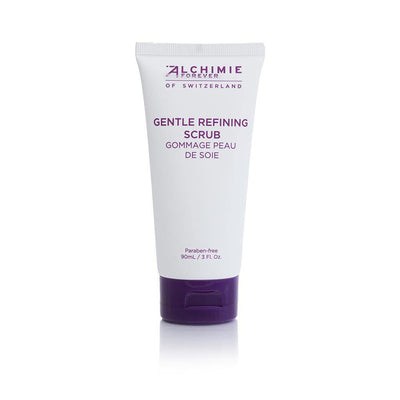
Alchimie Forever Gentle Refining Scrub
At Alchimie Forever, we believe effective exfoliation should deliver visible results without unnecessary irritation. Our Gentle Refining Scrub combines two complementary exfoliating approaches: jojoba pearls and cranberry particles provide physical exfoliation, while papaya enzyme offers enzymatic exfoliation.
Together, these ingredients help remove dead surface skin cells, refine uneven texture, and reveal a smoother, brighter-looking complexion.
For best results, apply to clean, dry skin, massage gently without excessive pressure for 60-90 seconds, and rinse thoroughly. Follow with your favorite Alchimie Forever moisturizer to help keep skin hydrated and comfortable.
Exfoliation Tips
Here are a few tips to keep in mind as you add exfoliation to your skin care regimen:
- Exfoliation is a beneficial skin care step for all skin types and all skin tones.
- Exfoliation is particularly beneficial to more mature skin, as the natural cellular turnover system has slowed down.
- For most skin types, exfoliating once to twice weekly is enough.
- Mechanical exfoliators tend to be ideal for clogged pores and uneven complexions.
- Chemical exfoliators tend to be ideal for inflamed, acne-prone skin.
- Mechanical and chemical products can be combined but should not be used together (meaning not on the same day).
What Are The Signs Of Over-Exfoliation?
When it comes to exfoliation, more isn't necessarily better. Exfoliating too frequently or too aggressively can disrupt the skin barrier, leading to redness, tightness, dryness, flaking, and increased sensitivity. Your skin may even sting when applying products that normally feel comfortable.
If you notice these signs, take a break from exfoliating and focus on gentle cleansing, moisturizing, and sun protection until your skin has recovered. Remember, the goal of exfoliation is smoother, healthier-looking skin, not irritation.
Watch this video to learn more about our Gentle Refining Scrub.
Watch our Co-Founder and CEO Ada Polla speak about exfoliation in this video.