

How to Treat Hyperpigmentation and Dark Spots for a More Even Complexion

Hyperpigmentation is one of the most common skin concerns, showing up as dark spots, post-acne marks, sun spots, melasma, or patches of uneven skin tone. While these forms of discoloration can have different causes—from sun exposure and inflammation to hormonal changes—they all involve changes in the skin’s production of melanin. The good news is that with consistent sun protection, targeted skincare ingredients, and the right routine, you can help prevent new dark spots from forming and improve the appearance of existing discoloration. Here’s what you need to know about hyperpigmentation, why it happens, and how to achieve a brighter, more even-looking complexion.
1. Where Does Pigmentation Come From?
Our skin’s pigmentation is melanin, made by special cells in our skin that are responsible for the production of melanin. When these cells are healthy and working, our pigmentation is even and bright. When these cells get damaged, or become unhealthy, our skin’s pigmentation starts to be uneven (hyperpigmentation = more pigmentation, hypopigmentation = less pigmentation).
2. What Is The Fitzpatrick Skin Type System?
The Fitzpatrick skin type (also known as phototype) refers to the amount of melanin in one’s skin (hence to skin color).
| Fitzpatrick Skin Type | Typical Skin Characteristics | Reaction to Sun |
|---|---|---|
| Type I | Very fair skin | Always burns, never tans |
| Type II | Fair skin | Burns easily, tans minimally |
| Type III | Light to medium skin | May burn, gradually tans |
| Type IV | Medium to olive skin | Rarely burns, tans easily |
| Type V | Brown skin | Very rarely burns, tans readily |
| Type VI | Deeply pigmented brown to dark brown skin | Almost never burns, deeply pigmented |
Dermatologists often use the Fitzpatrick Skin Type classification to describe how different skin types respond to UV exposure. While hyperpigmentation can affect every skin tone, people with more melanin-rich skin may be particularly prone to post-inflammatory hyperpigmentation following acne, irritation, or other forms of inflammation.
3. What Causes Dark Spots?
There are three main causes for an uneven pigmentation:
- The sun: UV rays cause what is typically referred as age spots (aka dark spots).
- Acne: post-inflammatory hyperpigmentation refers to those small dark spots that mark the area where a pimple used to be. This is a form of scarring.
- Hormones: uneven pigmentation referred to as “pregnancy mask” (aka melasma) are caused by changes in various hormone levels.
4. Why Do My Dark Spots Keep “Coming Back”?
There are two answers to this. The first is that some dark spots, in particular if left untreated, get darker with UV exposure. It is thus possible that your dark spots get darker in the summer, and naturally lighter in the winter – hence the impression of “going away” and “coming back.” This is typical with hormonal brown (melasma), and wearing lots of sunscreen during the summer months is a great way to prevent this.
The second answer is that what you are seeing is not actually the same dark spot coming and going away – but rather you are seeing new dark spots make their way up to your epidermis. They are not “old” spots coming back, but “new” spots making their appearance.
5. What Are The Best Ingredients To Treat Dark Spots
- Alpha-arbutin has a powerful brightening effect, and unlike other skin brighteners, is not irritating. It helps to both prevent and correct brown spots and promotes an even complexion.
- Vitamin C and Vitamin C derivatives (we love ascorbic glucoside) are the ultimate ingredients for achieving brightening and antioxidant effects and treat age spots from sun damage. This antioxidant vitamin is also a critical determinant of skin’s resilience, which significantly is reduced as we age.
- Citrus is an ingredient that has anti-brown spot and complexion brightening properties, making it ideal in the treatment of pigmentation and uneven skin tone. It also reduces free radical production and helps to prevent signs of skin aging.
- Hop extract provides brightening effects by decreasing hyperpigmentation and irregularities caused by sun, stress and aging.
- Green tea (photoprotective properties, anti-brown spots effects) has numerous benefits when applied topically, as it contains epigallocatechin-3-gallate (EGCG), a powerful molecule that prevents the disintegration of collagen and supplies photo-protective properties. Green tea also helps to repair the look of existing UV damage on the skin.
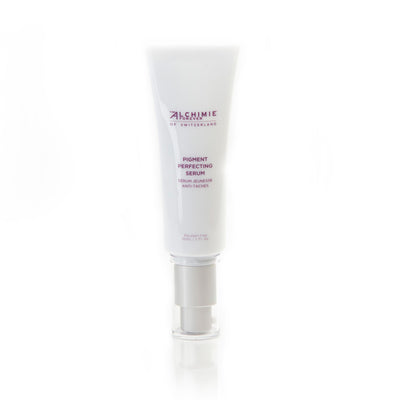
And guess what - all of these ingredients are found in our Pigment Perfecting Serum.
6. How To Use Pigment Perfecting Serum
This serum is to be used on the whole face, not as a spot treatment - because it does both prevention and correction.
This serum is safe to use year-round, morning and evening. Unlike many pigmentation products, this serum does not contain any ingredient that is photo-sensitizing, meaning it is not “dangerous” to use in sunny weather. We highly recommend using this during the summer months, as indeed this is the exact time during which our dark spots tend to form and get darker!
This serum is safe for all skin tones. This is not a bleaching product - we do not use hydroquinone or steroids.
This serum is safe for nursing and pregnant women.
7. Prevention is key!
The best way to treat dark spots is to prevent dark spots. The key to preventing dark spots and maintaining a bright, even complexion is to use a moisturizer with SPF daily, on your face but also on the neck, décolleté, arms and hands.